Choose timezone
Your profile timezone:
The 5th Neutrino Physics and Machine Learning (NPML 2026) will take place at the University of California, Irvine, USA. The NPML conference series are dedicated to identifying new opportunities, developing and sharing firm knowledge base, and building the future visions for impactful Artificial Intelligence and Machine Learning (AI/ML) research for neutrino physics.
We look forward to your contributions to share the latest AI/ML research advancements at all levels of applications in neutrino physics, including experimental design optimization, detector operations and calibrations, physics simulations, data reconstruction, and physics inference.
We invite both individual speakers as well as representatives from a large collaboration in the neutrino community. Speakers from outside neutrino physics are also welcome to make contributions: your contributions will bring new insights and help us develop interdiciplinary research collaborations.
When you register, please pick the track in which you would like to give your presentation. There is no track specification for posters.
Please indicate your interest in the registration form. You do not need to submit a formal title nor abstract at the time of registration - this is to motivate early registration as soon as possible.
The submission deadline of a formal title and abstract is April 30th May 15th. When the official title and abstract are ready, please submit them from the Call for Abstracts page.
At NPML, we strongly encourage speakers of oral presentation to also consider a poster presentation which allows participants to interact more in depth with you and learn about your research.
Meeting Venue:
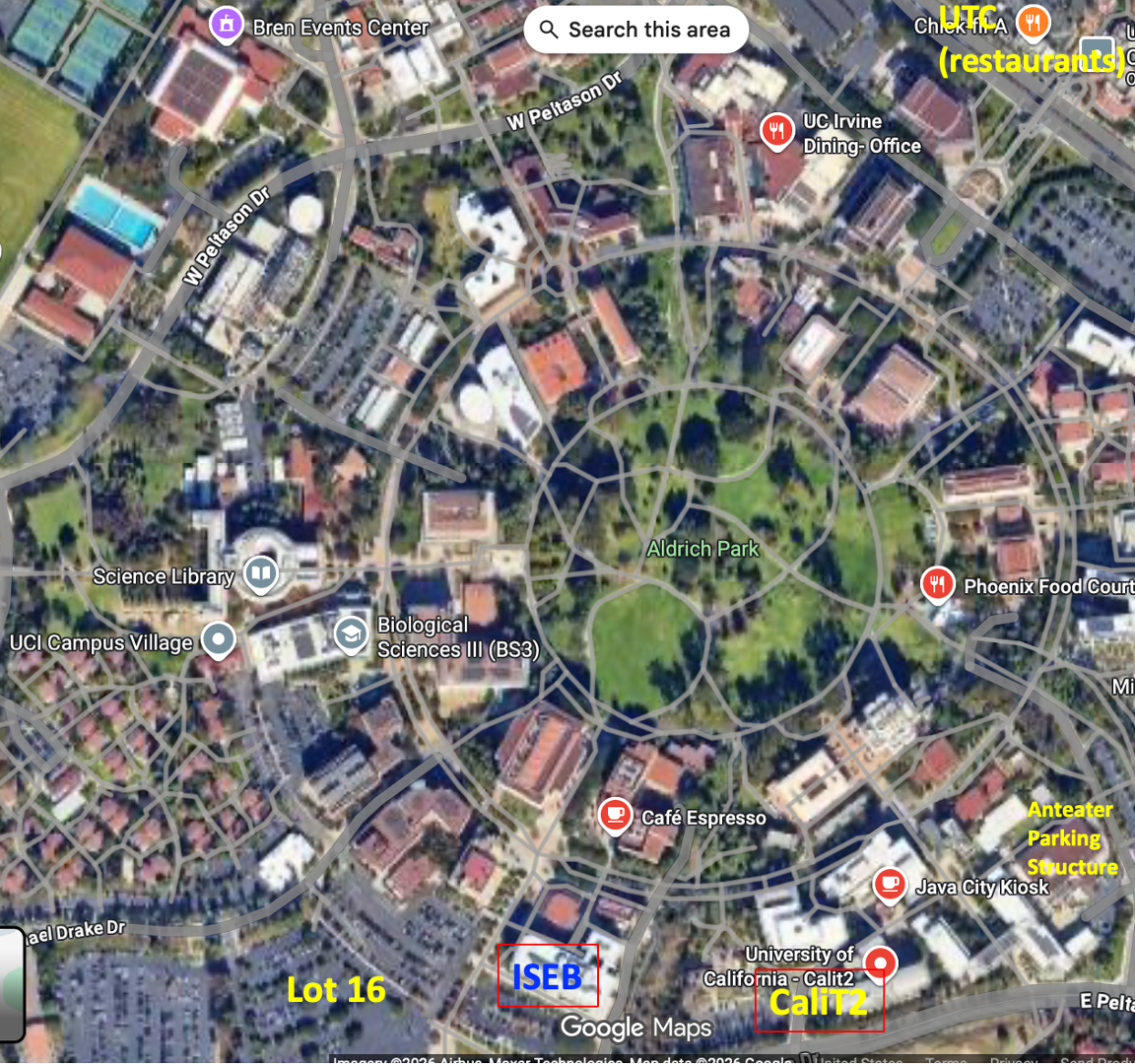
June 15-17 (Monday-Wedensday) Interdisciplinary Science and Engineering Building (ISEB)
Auditorium 1010
Map: https://maps.app.goo.gl/evVppT6QThjCccnE7
June 18-19 (Thursday-Friday) California Institute for Telecommunication and Information Technology (Calit2) Auditorium
Map: https://maps.app.goo.gl/7L7LqUrDmprEwgAB9
Getting to the Meeting Venue:
You may get to Meeting Venue directly by Uber/Lyft/Taxi
Irvine has public transportation, including public buses.
If you come by a rental car, you can find driving directions and freeway maps at the UCI campus maps page. The UCI Physics department visitor webpage has additional information, maps, and photos to help you find your way.
If you are driving or taking a taxi or shuttle, we recommend print a UCI map and bring it with you.
Map:
Parking:
Food
Food choices close to the meeting venue:
Café Espresso: https://maps.app.goo.gl/2LDRq2JY7YAExWmc8
Java City Kiosk: https://maps.app.goo.gl/2CRWFJ2hYmyd1AWb6
Phoenix food court: https://maps.app.goo.gl/xXddTQskcfk4WdqY8
Other on-campus dinings: https://uci.mydininghub.com/en/locations
Close to Campus: University Town Center (UTC). Many restaurants: https://maps.app.goo.gl/jS6F2jJN7d78SUsS8
Nearby (times by car)
Constraining the ratio of flavors of astrophysical neutrinos at Earth informs neutrino production and oscillation scenarios. The IceCube Neutrino Observatory measures the neutrino flux by recording the Cherenkov light deposited by neutrino secondaries with around five thousand PMTs distributed within a cubic kilometer of ice at the South Pole. Tau neutrinos are difficult to distinguish from electron neutrinos due to the similar patterns of light deposited following their charged current interactions. With IceCube's detector configuration the similarity is strongest below around 100 TeV, and in this regime it becomes essential to leverage individual-PMT timing information. I will report on the development of a transformer neural network trained on electron neutrino and tau neutrino Monte Carlo that aims to distinguish the signatures of the two flavors on the TeV scale in IceCube data.
The Deep Underground Neutrino Experiment (DUNE) is the flagship next-generation neutrino experiment in the United States, designed to decisively measure neutrino CP violation and determine the neutrino mass hierarchy. DUNE employs Liquid Argon Time Projection Chamber (LArTPC) technology, which provides exceptional spatial resolution and enables detailed reconstruction of final-state particles and neutrino interactions.
Artificial intelligence and machine learning (AI/ML) techniques—such as convolutional neural networks, graph neural networks, and transformers—are being actively developed within DUNE and have already demonstrated strong performance in signal processing, kinematic reconstruction, clustering, and interaction/particle identification. Beyond reconstruction, AI/ML methods are playing an increasingly important role in simulation, trigger and DAQ data processing, beam design and monitoring, documentation search, and quality assurance/quality control (QA/QC). More recently, DUNE has also begun exploring emerging AI approaches, including foundation models, large language models (LLMs), vision–language models (VLMs), and agentic AI systems. At the infrastructure level, DUNE extensively leverages leadership-class and distributed scientific computing infrastructures to support large-scale AI/ML workflows.
In this talk, I will review recent AI/ML advances and computing infrastructure in DUNE.
Precise reconstruction of high-energy neutrino interactions at the LHC is critical for the physics program of the proposed FASERCal detector, an off-axis neutrino detector for the FASER experiment during LHC Run 4, enabling precision measurements of TeV-scale neutrino interactions in the far-forward region. The detector's highly granular, 3D voxelized geometry produces sparse data that challenges conventional reconstruction techniques. Our model integrates a Submanifold Sparse Convolutional embedding layer with a hierarchical Transformer encoder, employing attention mechanisms designed to capture features at multiple spatial scales—learning both fine-grained local shower structures and the global event topology. A Perceiver-IO–style bottleneck fuses multi-modal inputs from scintillator voxels, hadronic calorimeters, and muon spectrometers. By leveraging a Masked Autoencoder (MAE) pre-training scheme, the model learns robust representations of particle shower development, overcoming the limitations of standard supervised learning. It is trained via a multi-task objective combining patch energy reconstruction and semantic segmentation, and the resulting encoder is fine-tuned for multi-task classification and kinematic regression with task-specific cross-attention heads. The framework achieves high-purity identification of $\nu_e$ and $\nu_\mu$ charged-current and neutral-current events, and provides first indications of sensitivity to tagging rare $\nu_\tau$ events. We demonstrate that this approach achieves highly accurate reconstruction of particle showers, providing precise estimates of the visible energy $E_\text{vis}$ and missing transverse momentum $p_T^\text{miss}$, as well as reliable reconstruction of lepton and jet momenta for every event, even in complex topologies.
The Liquid Argon Time Projection Chamber (LArTPC) technology provides high-resolution spatial and calorimetric information which can lead to great capabilities for particle identification. MicroBooNE was one of the first large LArTPC experiments to operate in a neutrino beam. This talk presents the integration of NuGraph2, a reconstruction tool based on machine learning (ML), into MicroBooNE’s reconstruction and analysis workflow. We will discuss the effort in deploying this ML-based reconstruction tool on real LArTPC neutrino data, including strategies for minimizing simulation-induced bias and assessments of robustness against detector systematics, as well as its impact on reconstruction performance and downstream physics analyses.
NuGraph2 is a graph neural network developed for neutrino event reconstruction. The network makes hit-level predictions, including a cosmic vs. neutrino interaction classifier and a semantic decoder which labels the hits according to their particle types. In MicroBooNE, we have integrated NuGraph2 with Pandora to form a combined reconstruction framework with significantly improved performance. The cosmic filter allows us to better reject cosmic rays, while the semantic labels are utilized for better particle identification. These reconstruction-level gains also translate to enhancement in physics analyses. This includes cases that were not explicitly targeted during the network training, such as Beyond the Standard Model (BSM) models with e+e- final states.
Most existing and proposed high energy neutrino experiments have excellent muon charge identification capabilities, enabling the distinction of $\nu_\mu$ and $\overline{\nu}_\mu$ charged current interactions. In contrast, distinguishing $e^\pm$ from $\nu_e$ and $\overline{\nu}_e$ interactions is typically impossible, as they interact quickly within the characteristically dense detector material, failing to reach the spectrometer. However, installing a compact and cost-effective plastic target right before the spectrometer would enable the first separate measurement of $\nu_e$ and $\overline{\nu}_\mu$ cross sections at high energy, and excellent signal identification is obtained by training a boosted decision tree to identify the signal events from neutral current and muon charged current backgrounds. At collider neutrino experiments such as FASER, the Forward Physics Facility, or SHiP, the proposed auxiliary detector opens new opportunities for studying forward particle production at collider neutrino experiments. In particular, it allows constraining forward $\Lambda$ hyperon production at the LHC, thus helping to reduce flux uncertainties also for the combined $\nu_e+\overline{\nu}_e$ measurement of the main detector.
Accurate position reconstruction in noble-element time-projection chambers is critical for rare-event searches in astroparticle physics, yet is systematically limited by electric field distortions arising from charge accumulation on detector surfaces. Conventional data-driven field corrections suffer from three fundamental limitations: discretization artifacts that break smoothness and differentiability, lack of guaranteed consistency with Maxwell's equations, and statistical requirements of $\mathcal{O}(10^7)$ calibration events. We introduce a physics-informed continuous normalizing flow architecture that learns the electric field transformation directly from calibration data while enforcing the constraint of field conservativity through the model structure itself. Applied to simulated ${}^{83\mathrm{m}}$Kr calibration data in an XLZD-like dual-phase xenon detector, our method achieves superior reconstruction accuracy compared to histogram-based corrections when trained on identical datasets, demonstrating viable performance with approximately $8.9 \times 10^4$ events---a \textbf{50 times reduction} in calibration data requirements for a comparable performance to a field distortion correction map generated from approximately $4.5 \times 10^6$ events. This approach can enable practical monthly field monitoring campaigns, propagation of position uncertainties through differentiable transformations, and enhanced background discrimination in next-generation rare-event searches.
Water Cherenkov neutrino detectors present unique opportunities and challenges for the application of machine learning techniques. The Super Kamiokande detector is a 50 kiloton detector set up for a multitude of neutrino and non-neutrino physics, including that of detecting neutrinos from the T2K experiment 295km away. The flavour of neutrino as well as its interaction vertex and direction are all crucial observables for $\delta _{CP}$ and other searches being performed by T2K. Reconstructing these observables from PMT charge and time is well-suited to machine learning techniques, given the large multiplicity of final states, multivariate inputs and intractable size of the detector. In this talk, I will present the set up of the first application of a neural network, namely ResNet, to reconstruct neutrino interactions in the Super Kamiokande detector at the energy ranges typical of T2K. I will highlight the improvements which ResNet is capable of with respect to traditional algorithms. Furthermore, I will highlight the challenges we have encountered in applying this network to real Super Kamiokande data, the techniques we used to study data-simulation differences and our solutions to the difficulties which were encountered in applying neural networks to the data. Finally, I will end with a glimpse to the future and where ML can really shine when it comes to neutrino searches in water Cherenkov detectors.
Monolithic liquid scintillator detectors are searching for neutrinoless double beta decay, a theorized process that would confirm the Majorana nature of neutrinos. The production and propagation of photons in the detection medium depend on various optical properties, such as light yield, attenuation lengths and re-emission/absorption spectra. These must all be separately characterized, resulting in several independent optical parameters, some of which are highly correlated. This, in addition to the high dimensionality of the data, makes this an ideal problem for machine learning.
The Eos experiment is a tonne-scale optical detector operating at UC Berkeley. Commissioned in 2024, Eos serves as a testbed for next generation detector technologies for neutrino experiments. This work presents the use of surrogate models via simulation-based inference (SBI) to tune Eos optical parameters. Trained on simulations generated via the RATPAC2 framework, the model learns the conditional likelihoods of key detector observables conditioned on the optical parameters; light yield, scattering length, and absorption length. With the learned conditional likelihood, Bayesian sampling of the posterior allows us to perform inference on parameter values using extensive calibration data. In the future, we hope to apply this method to larger detectors such as SNO+.
Accurate characterization of scintillation emission profiles is essential for robust event reconstruction in liquid scintillator detectors. The SNO+ Collaboration has developed an innovative framework employing Bayesian optimization (BO) to calibrate these timing profiles using internal radioactive backgrounds. Our results demonstrate that BO achieves convergence in at least an order of magnitude fewer iterations compared to traditional grid-search methods. This significant gain in efficiency establishes BO as a robust, reliable approach for accelerating fitter reconstruction and streamlining detector performance during both the commissioning phase and long-term operations.
Detector simulation in liquid argon time projection chambers (LArTPCs) is a constant challenge. In particular the modeling of electrons response on wires is highly nontrivial. However, new machine learning techniques exist which can be leveraged to ameliorate these concerns. We present a novel methodology to attempt to learn from cosmic muon data in the ICARUS detector how reconstructed wire signals are influenced by features of the hits such as location, particle direction, angle relative to the wire plane, etc. A model can then be generated which can apply the learned mapping to Monte Carlo events to create a more data-like simulation sample. By creating such a sample we expect to reduce the systematic uncertainties at ICARUS due to our detector modeling.
High-resolution neutrino detectors typically rely on fine detector segmentation to obtain detailed spatial information, which introduces substantial complexity, channel count, and cost. In this talk, I will present the deep-learning reconstruction developed for PLATON, a detector concept based on plenoptic imaging of scintillation light in an unsegmented scintillator volume. The central challenge is to infer the three-dimensional topology of charged-particle tracks from extremely sparse, photon-starved SPAD-array images collected by multiple plenoptic cameras. Using simulated neutrino interactions validated on prototype data, we show that deep learning can reconstruct detailed 3D event information from these optical measurements. The network predicts the 3D origins of detected scintillation photons, producing a point cloud that is subsequently used to reconstruct particle tracks, vertices, and final-state topologies. In simulated charged-current neutrino interactions, this approach achieves sub-millimetre spatial reconstruction, with resolutions down to the few-hundred-micrometre scale, enabling efficient reconstruction of multi-proton final states relevant to neutrino–nucleus interaction modelling. I will also discuss ongoing studies of the scalability of this approach to larger detector volumes and of what the neural network learns about the underlying optics, suggesting a path towards scalable, high-resolution event reconstruction in monolithic scintillator detectors.
NOvA is a long-baseline neutrino experiment studying neutrino oscillations by detecting neutrinos from the NuMI beam at Fermilab. Its physics analysis relies on accurate prong segmentation, which involves matching each hit to its source particle and identifying the particle type. This task has commonly been addressed using a combination of traditional clustering algorithms and convolutional neural networks (CNNs). However, NOvA’s detector design presents data as two sparse and decoupled 2D images (XZ and YZ views) rather than a native 3D representation, posing a significant challenge for traditional CNN-based models.
In this talk, we propose a novel neural network based on the Point Set Transformer. By treating detector hits as sparse point clouds and implementing a cross-view attention mechanism, our model enables efficient information mixing between both views. Evaluated on NOvA simulated data, our model achieves superior accuracy while requiring significantly fewer computational resources compared to other models. Furthermore, the model demonstrates great performance when applied to Liquid Argon Time Projection Chamber (LArTPC) data, which shows its potential as a universal prong segmentation algorithm for multiple view neutrino detectors.
Direction reconstruction in liquid scintillator detectors is challenging because the directionality is due to Cherenkov light, which is typically a small fraction of scintillation light especially with high concentrations of the wavelength shifter. We present a deep learning framework tailored to this regime, based on a purpose-built Dual-Temporal Attention architecture that combines point-cloud representations of detected photon hits, self-attention for learning long-range spatiotemporal correlations, and an adaptive time-gating mechanism designed to emphasize possible Cherenkov-like hits. The method is developed specifically for unordered detector hit patterns, in which directional information is sparse and embedded within overwhelming scintillation backgrounds. Training is performed on approximately 20 million simulated electron events with detector-condition variations, including scintillation rise-time augmentation, to improve robustness against simulation-dependent effects. The model is evaluated on simulated test events and further validated on a sample of real solar-neutrino candidate events from the SNO+ data with full wavelength shifter concentration. In both simulated and real data, the reconstructed direction distributions are consistently biased toward the true direction in both cases, indicating only limited sim-to-real degradation. These results demonstrate that detector-specific attention architectures can recover physically meaningful directional information. This work points to a promising technical pathway for machine-learning-driven reconstruction in neutrino detectors, with broader relevance to sparse, weak-signal inference problems in experimental particle physics.
Accurate photon timing in large liquid-scintillator neutrino detectors requires precise modeling of complex optical processes. These include complex scattering, absorption and re-emission, boundary effects, steel-frame shadowing, and multi-path reverberation. These effects draw a complex picture that is yet intractable for analytic methods and too detector-specific to learn end-to-end. We present a hybrid physics--ML architecture, RTE--cNSF, designed for the JUNO detector, which combines a physics-based radiative transfer equation (RTE) solver with a conditional neural spectral field (cNSF) to model these processes.
The architecture enforces a strict first-hit handoff boundary: the RTE handles light propagation inside the liquid scintillator up to the acrylic boundary, while a frozen cNSF --- trained on filtered GEANT4 tracks --- captures all subsequent water-buffer physics. Exploiting the SO(2) symmetry of individual PMTs, the neural model operates on a compact, three-parameter local invariant space, preventing the leakage of source-specific information into the boundary model.
The spatial integration is trifurcated into three topologically disjoint pipelines: a target-driven Fermat path solved analytically via 1D auto-differentiation (JAX) with a symmetry-reduced Jacobian; a diffuse direct-light channel sampled over a 2D Sobol sequence with an orthogonality veto mask; and a scattered-light channel over a 5D boundary manifold. The resulting optical delay kernel is assembled by convolving the spatially integrated flux with the cNSF timing distribution, the scintillator emission profile, chromatic dispersion, and the PMT transit-time spread via FFT, preserving full differentiability for parameter inference.
This work aims to provide a computationally efficient and physically accurate model for photon timing in the JUNO detector, enabling improved calibration, event reconstruction, and ultimately enhancing the sensitivity of neutrino measurements.
The Jiangmen Underground Neutrino Observatory (JUNO) is the largest liquid scintillator detector in the world, aiming to determine the neutrino mass ordering with an energy resolution of $3\%/\sqrt{E~[\mathrm{MeV}]}$. Accurate analysis of photomultiplier tube (PMT) waveforms is essential for energy resolution. We present a deep learning framework for PMT waveform denoising and reconstruction. Our framework deploys a Transformer-UNet denoising network followed by a Transformer encoder for parameter estimation, to address the challenges of single photoelectron response (SER) calibration under real noise conditions and multi-photoelectron (multi-PE) pile-up. We introduce a simulation-based supervised learning framework which incorporates physics-based pulse models and data-driven noise. A function-space distribution estimation framework calibrates SER characteristics across different PMT individuals. Experiments on the Pan-Asia ContainerD dataset demonstrate that our method achieves the Residual Sum of Squares (RSS) of 2.68~mV$^2$ and Wasserstein distance of 0.61~ns on multi-PE reconstruction, which demonstrates better performance than other existing methods. The framework handles hardware-dependent non-Gaussian electronic noise and baseline drift, outputs physically interpretable parameters with uncertainty estimates, and enables direct integration into maximum likelihood reconstruction pipelines.
I will present a search for a hypothetical heavy neutral gauge boson (Z′) decaying to dilepton pairs using machine-learning classifiers trained exclusively on low-mass kinematic sidebands. A gradient boosted decision tree (BDT) and a multi-layer perceptron deep neural network (DNN) are trained to distinguish Z-peak events from Drell-Yan background events using only 11 raw kinematic features, with dilepton invariant mass deliberately excluded to avoid background sculpting in the search region. The analysis uses proton-proton collision data with √s = 13 TeV recorded by the ATLAS experiment during LHC Run 2 in 2015, released through the CERN Open Data portal in 2024.
Both classifiers achieve strong discrimination on the held-out test set (AUC of 0.9869 and 0.9996 for the BDT and DNN respectively). Events in the blinded high-mass search region (mℓℓ > 250 GeV) are categorized by classifier score, a smooth three-parameter parametric function is used to model the background, and a bin-by-bin Asimov significance scan is performed. We observe no statistically significant excess, with the largest local deviation at mℓℓ = 1120 GeV at a significance of 2.40σ in the DNN's highest-score category.
The χ²/ndf ≈ 1.0 background fits confirm that the sideband-only training strategy preserves the background shape, demonstrating that ML classifiers can be used in bump-hunt searches without sculpting the spectrum. This methodology of concentrating signal-like events into high-score categories while preserving a smooth, fittable background is directly transferable to rare-event searches in neutrino physics and other BSM contexts. The analysis is fully reproducible and built entirely on public data.
Cryogenic detectors aiming to push detection thresholds to ever lower energies must operate close to the noise limit, where reducing the threshold further risks increasing false triggers. The DELight experiment will use a superfluid helium detector instrumented with large area cryogenic microcalorimeters to probe sub-GeV dark matter via faint quasiparticle and photon signals.
We formulate reconstruction as a noise-aware representation learning problem, aiming to improve sensitivity to faint signals and thereby extend reach to lower dark matter masses. Starting from an optimal filter, we generalize to expectation-maximization principal component analysis (EMPCA), which learns signal subspaces under the noise covariance metric, extending matched filtering to a data-driven, multi-dimensional setting.
Using simulated traces with realistic per-channel noise and controlled cross-channel correlations, we compare optimal filtering and EMPCA, suggesting improved robustness and energy resolution for faint signals. In the simplest one-component case, EMPCA reduces to the optimal filter, while multi-component models capture additional structure beyond template-based approaches. In this view, EMPCA can be interpreted as a noise-weighted linear autoencoder under quadratic loss, linking classical reconstruction to modern representation learning.
This framework naturally extends toward nonlinear representation learning, providing a pathway to integrate deep learning methods. For DELight, this enables more robust reconstruction near threshold, improving sensitivity to low-energy events. More broadly, the approach applies to rare-event experiments with multi-channel time-series data, where signal shapes vary and noise can be non-stationary and correlated across channels.
We present a data-driven approach for the generation and inference of 2D LArTPC events. Using a conditional latent diffusion model trained on LArTPC images, we have demonstrated the generation of physically realistic protons. Combining this conditional model with Earth Mover’s Distance (EMD) enables us to perform stochastic gradient descent to efficiently infer the 3D momentum of an input image and subsequently generate physically similar events. This same framework naturally serves as a discriminator of the number and types of particles present in LArTPC images. Because this approach requires no underlying physics simulation, it is particularly appealing for regimes where traditional event generators struggle.
NuGraph3 is a hierarchical Graph Neural Network (GNN) architecture for event reconstruction in neutrino physics experiments, utilized across a range of Liquid Argon Time Projection Chamber (LArTPC) experiments including MicroBooNE, ICARUS, SBND and DUNE. This third-generation architecture leverages a range of different decoders to predict multiple outputs simultaneously on a heterogeneous graph structure, including semantically labelling detector hits, removing background noise, clustering hits into particles, and predicting event-level quantities such as neutrino event vertex and interaction type. This talk will present recent developments to refine the clustering task, in order to provide a full end-to-end event reconstruction from low-level inputs.
The 2x2 Demonstrator is a prototype of ND-LAr, the liquid argon time-projection chamber of the Deep Underground Neutrino Experiment's Near Detector complex. Both the 2x2 Demonstrator and ND-LAr are modular detectors with pixelated charge readouts and inactive regions wherein there is no sensitivity to energy depositions in the liquid argon. These inactive regions are located between the active detector modules, creating the challenge of inferring what the missing charge signals should look like in these regions. This study explores the use of a dual-decoder generative sparse 3D convolutional neural network to infer missing charged-particle track and shower structure and the energy lost in the inactive regions of the 2x2 Demonstrator and ND-LAr. Results indicate that this approach shows promise in predicting missing energy depositions and topology in dead regions with good accuracy.
As we enter the era of precision in neutrino physics, it is essential to better understand and limit systematic uncertainties in experimental setups. With the improvement of statistics and measurement quality in detectors, the uncertainties arising from Monte Carlo (MC) generators, used throughout the data analysis process, become more relevant. These uncertainties stem from limitations in the theoretical descriptions of neutrino interactions with atomic nuclei. We propose an alternative framework to conventional MC generators by employing machine learning algorithms that can learn directly from experimental measurements, even in scenarios with limited data availability. In particular, we demonstrate that Generative Adversarial Networks (GANs) can be implemented to describe the kinematics of the resulting lepton in the muon neutrino Charge Current scattering off nuclei, as a function of the incoming neutrino energy. Furthermore, we show that the physics learned by GANs can be used to improve the training efficiency of a model under different neutrino scattering configurations.
Liquid Argon Time Projection Chambers (LArTPCs) are a leading detector technology for precise 3D imaging and reconstruction of neutrino interactions, offering millimeter-scale spatial resolution. The SPINE (Scalable Particle Imaging with Neural Embeddings) reconstruction chain employs Sparse Convolutional Neural Networks for voxel-level feature extraction and Graph Neural Networks for particle-level clustering, forming a unified, hierarchical end-to-end pipeline for particle interaction reconstruction. In its current form, SPINE operates as a purely feed-forward pipeline, making downstream tasks such as instance clustering directly dependent on the accuracy of upstream outputs such as semantic segmentation — errors propagate without correction. This work introduces SPINE++, an iterative training strategy that couples semantic segmentation and instance clustering in a closed feedback loop, allowing each task to mutually refine the other across training iterations. We demonstrate that this approach yields significant improvements in reconstruction performance, achieving >85% reduction in segmentation errors, with the largest gains in challenging, high-density energy deposition areas.
Previously, we presented Panda (arXiv:2512.01324), a scalable point cloud architecture and training method that learns reusable sensor-level representations directly from raw, unlabeled 3D TPC data. We showed that this method–a UNet-like point cloud encoder coupled with a multi-view self-distillation objective–produces an encoder with foundation-model-like behavior: its self-taught representations reach state-of-the-art semantic segmentation with 1,000x fewer labels, and Panda Detector, a set-prediction head ~5% the size of the encoder, goes from raw inputs to full event reconstruction in a single forward pass with accuracy comparable to current methods, in contrast to modern hierarchical multi-algorithm or -network approaches.
In this talk, we will show that the same methods (Panda and Panda Detector) apply to a fundamentally different data modality. In a LArTPC, the data is a 3D point cloud tracing each particle's path; in a water Cherenkov detector, these paths are never seen. Instead, only the ring of light it casts onto a fixed wall of photomultiplier tubes is recorded. Using the new WAND dataset of simulated Super-Kamiokande-like events, we show that different event types (e/μ, e/π⁰) separate naturally over the course of training. Panda Detector applies neatly to ring counting, PID, and regression of vertex position, direction, and particle energy—again in a single forward pass. We present preliminary results on all of these, including reconstructing invariant mass of neutral pions.
In contrast to detector- (and often analysis-) specific pipelines, this work points towards more general methods that transfer across modalities, perhaps eventually to a single cross-experiment foundation model.
The DUNE near detector will face high interaction rates that stress traditional optical reconstruction pipelines relying on heuristic metrics for interaction detection. To achieve a flexible, data-driven solution and narrow sim-to-real gaps, we explore self-supervised pretraining for optical waveform reconstruction in liquid argon time projection chambers. We pretrain a Conformer-based masked autoencoder on synthetic single-PMT optical waveforms and finetune for interaction time detection, evaluating against supervised baselines in flash detection accuracy and photon count regression. We further extend this framework to multi-PMT waveforms with signal rates comparable to a challenging environment such as the DUNE near detector LArTPC, where the model learns structured spatiotemporal representations. We present quantitative results assessing whether masked autoencoding can serve as a scalable, label-efficient pretraining strategy for optical reconstruction in next-generation LArTPC detectors.
Recent advances in machine learning, particularly in multimodal models, have created new opportunities for analyzing complex data in high-energy physics, where accurate identification of particle interactions is critical for scientific discovery. However, existing approaches rely heavily on convolutional neural networks, which lack interpretability and do not fully leverage multimodal reasoning capabilities. Here we show that a fine-tuned Vision Language Model (VLM) based on LLaMA 3.2 can effectively identify neutrino interactions in pixelated detector data, outperforming both a state-of-the-art convolutional neural network and a Vision Transformer baseline in classification accuracy and robustness. In addition, the VLM provides improved explainability through reasoning-based, interpretable predictions and supports integration of auxiliary semantic information. These results demonstrate the potential of multimodal transformer architectures as general-purpose tools for physics event classification, paving the way for more transparent, flexible, and scalable analysis methods in future high-energy physics experiments.
The IceCube Neutrino Observatory is a neutrino detector located at the South Pole consisting of a three-dimensional array of optical sensors embedded deep within the Antarctic ice. It records the Cherenkov radiation produced by charged particles that are generated when neutrinos interact in the ice. The trajectory of the interacting neutrino can be inferred by analyzing the spatio-temporal distribution of the observed Cherenkov light. Muon tracks from high-energy, charged-current muon neutrino interactions are of particular interest for neutrino astronomy due to their sub-degree angular resolution. The current state-of-the-art reconstruction method, used to analyze IceCube's high-statistics samples of these events, assumes that Cherenkov light is emitted uniformly along the muon trajectory. It relies on knowing the corresponding photon arrival time distributions for each event and sensor combination. These PDFs were extracted from detector simulations using dated interpolation techniques that do not scale to the current complexity of the problem. Here we present a machine learning approach, using a mixture density network to extract new state-of-the-art photon arrival time distributions with an improved model for the properties of Antarctic ice. Building on the improved correctness of the PDFs and including information about the muon energy loss pattern, we devise methods to mitigate the impact of stochastic energy losses on the angular reconstruction. We compare the performance of the new methods to the current standard by leveraging a novel GPU-accelerated JAX implementation of the reconstruction method that greatly reduces the runtime of the algorithm.
Bridging the gap between data and simulation is one of the most persistent challenges in modern particle physics experiments. Detector calibration aims to shrink this gap by improving the fidelity of detector modeling. Conventional calibration workflows address individual detector effects sequentially. Differentiable simulation offers a compelling alternative: by propagating gradients through the full detector response, all physics parameters can be optimized simultaneously in a single coherent workflow — replacing a fragmented process with one unified, correlation-aware optimization loop. I will present a workflow of calibrating a liquid argon time projection chamber using differentiable simulation, and draw comparisons to conventional calibration approaches to highlight the advantages and challenges, including calibration data input and computational need.This talk will present an assessment of where gradient-based calibration stands today and where the most promising opportunities lie ahead.
We present a GPU-native simulation framework for liquid-argon neutrino detectors that enables efficient simulation and signal processing of sparse data in dense GPU-oriented workflows. Traditional dense FFT-based methods in liquid-argon detector simulation are adapted to sparse signals through blockwise processing and analytic tensor operations. We develop an efficient block-sparse binned tensor abstraction that preserves detector locality, supports batched parallel execution on GPUs, and reduces memory usage. We also introduce a new algorithm for signal processing on zero-suppressed data, overcoming the traditional assumption of dense full-waveform input. Implemented in PyTorch, the framework bridges machine-learning software ecosystems and high-performance scientific computing for next-generation neutrino experiments, using the liquid-argon time projection chamber of the DUNE Near Detector as a representative case study.
Optical photon tracking in Geant4 is the dominant cost in simulating large neutrino detectors that rely on scintillation or Cherenkov light, and it caps the size of training samples available for ML-based reconstruction. Simphony (old name eic-opticks) is a GPU optical simulation framework built on Opticks (originally developed for JUNO) that runs inside a standard Geant4 job and delivers two orders of magnitude speedup over CPU tracking. We extend Opticks with asynchronous GPU execution that overlaps optical propagation with Geant4 stepping on the CPU, cutting walltime further on production workflows. We have also implemented wavelength-shifting that is essential for certain neutrino detectors.
On top of the speed gains, simphony propagates Monte Carlo truth through the GPU stage, every detected photon carries the pointer to the charged particle that created it. The truth propagation preserves the per-photon labels that supervised training on photon-level tasks requires with minimal performance penalty.
We report validation on a simplified DUNE FD2-VD geometry against Geant4. Together, these capabilities open up workloads that were previously impractical at scale: ML training sample generation, end-to-end detector geometry optimization, and systematic uncertainty studies that require scanning many optical configurations. Simphony is packaged as a framework-independent module so other experiments are able to adopt it.
Liquid argon time projection chambers (LArTPCs) at DUNE and SBN need fast simulation, automated event reconstruction, and precise detector calibration, which are usually handled by separate tools. We built JAXTPC, a single differentiable detector simulator that unifies all of three tasks. Powered by JAX for efficient parallelization, JAXTPC models the full LArTPC response, from charge recombination and electron drift through the diffused field response, electronics, and noise, across detector geometries and wire or pixel readout. It runs about 100× faster on GPU than conventional CPU pipelines, making large, fully-labeled datasets practical to generate; a multi-million-event open dataset is in production.
The same model opens new ways of addressing reconstruction and calibration through automatic differentiation and high dimensional gradients. Reconstruction recovers an event from its wire signals, either as a parametric particle or as free charge segments initialized by a neural network. Calibration tunes detector parameters such as recombination, electron lifetime, and diffusion simultaneously. Optimization quality depends heavily on the choice of loss. An electrostatics inspired Sobolev loss matched to the sparse wire images enables both processes by providing a richer landscape. In closure, reconstructed charge agrees with truth to better than a percent, geometry to sub-millimeter, and the recovered calibration parameters to a few percent.
Numerous new physics models predict massive long-lived particles that can decay to muon pairs. However, searching for such dimuon beyond standard model signals in liquid argon time projection chamber-based neutrino experiments is challenging because of the nearly irreducible neutrino background that includes one muon and one pion in the final states. The primary limiting factor is the insufficient distinction between muons and pions due to their similar mass and minimum ionization energy deposition profile. To address this issue, we developed a novel AI-ML method using the Optimal Transport (OT) algorithm, which showed promise in classifying jets in large hadron collider data. Using a set of publicly available MicroBooNE simulation data containing about 10K well-reconstructed fully contained muon and pion tracks, we adapted this OT tool to separate muons from pions. Our OT algorithm leverages full 3D imaging of space points along the track trajectory with a focus on the difference in decay and capture behavior of the two particles in argon. The algorithm is optimized to correctly identify muons, ensuring high confidence in dimuon searches when requiring both tracks of two-track events to be classified as muons. The efficiency improvements for muon selection at 90% accuracy using the new OT method will be shown.
"Liquid argon time projection chambers (LArTPC) detector technology has been at the forefront of some recent (MicroBooNE, ICARUS) and future (Dune) large-scale Neutrino experiments. Due to LArTPC data’s interpretability as a collection of images, it has benefited from advances in ML methods, particularly in the field of computer vision. Yet, how to best apply these methods to 3D LArTPC environments is still an ongoing project. Sonata–a recently developed method of training sparse 3D point clouds using self-supervised learning (SSL)–demonstrates improved performance compared to previous point cloud networks (Wu et al., 2025), and thus could be well-suited for 3D LArTPC data.
Using MicroBooNE LArTPC events (MC baseline and 3 real-data pre-training variants), we applied Low Rank Adaptation fine-tuning to a Sonata-pretrained LArTPC point cloud foundation model. This talk will compare the results of fine-tuning on 2 tasks: particle segmentation and ghost point removal. We hope that this Sonata SSL plus fine-tuning approach of our LArTPC pointcloud can be extended in the future to other detectors with the same technology.
"
Wire-Cell is a mature, production-level LArTPC reconstruction framework that integrates physics-driven models with targeted machine learning to perform signal processing and 3D tomographic reconstruction. Current reconstruction approaches in Wire-Cell primarily exploit geometry, charge, and local connectivity, while higher-level topological information remains only partially encoded. In addition, reconstruction performance suffers from persistent simulation-to-data discrepancies arising from relying on Monte Carlo samples for development and training. Building on previous ML integrations, a Wire-Cell Foundation Model is being developed to learn rich topological and contextual representations directly from sparse detector data in a self-supervised manner. This model aims to encode global structure beyond local connectivity, while naturally mitigating the simulation-to-data gap. The resulting representations will provide a reusable substrate for downstream tasks including deghosting, clustering, vertexing, and particle-flow reconstruction. This talk will discuss the preparation of LArTPC data for self-supervised training, the model architecture, the initial training procedure, and preliminary studies of the learned representations and reconstruction performance.
Modern neutrino analyses are generally simulation-based, requiring some choice of underlying neutrino event generator. However, since different neutrino event generators vary significantly in their predictions, it is useful to test simulation-based analyses with different event generators to check for any dependencies on the choice of generator. This is often practically difficult to do due to the high computational cost of detector simulations. One way to circumvent the need for processing too many events through detector simulations is to reweight events of one generator to match the distribution of events from another in some chosen observables, but existing methods for doing this tend to be limited to only a few observables at a time. We present a transformer-based architecture that can reweight between neutrino event generators based on nearly the entire particle stack, providing reweighted events that are valid over a greatly expanded phase space.
Future AI-based studies in particle physics will likely start from a foundation model to accelerate training and enhance sensitivity. As a step towards a general-purpose foundation model for particle physics, we investigate whether the OmniLearned foundation model pre-trained on diverse high-$Q^2$ simulated and real $pp$ and $ep$ collisions can be effectively transferred to a few-GeV fixed-target neutrino experiment. We process MINERvA neutrino-nucleus scattering events and evaluate pre-trained models on two types of tasks: regression of available energy and binary classification of charged-current pion final states ($\mathrm{CC1\pi^{\pm}}$, $\mathrm{CCN\pi^{\pm}}$, and $\mathrm{CC1\pi^{0}}$). At the 3M-parameter scale, pre-trained OmniLearned-small consistently outperforms similarly sized scratch-trained models at matched compute budget and training steps. These results suggest that particle-level foundation models acquire inductive biases that generalize across energy scale, detector technology, and underlying physics, pointing toward a paradigm of detector-agnostic inference in particle physics.
The Deep Underground Neutrino Experiment (DUNE) aims to accomplish precision measurements of neutrino oscillation. DUNE will use the world’s most intense neutrino beam, expecting over 100 neutrino interactions in the near-site Liquid Argon detector per spill. Resolving the overlapping particle signatures in the near detector will be vital for providing precision neutrino oscillation measurements in tandem with the far site’s multiple, 17-kt, detectors. The near site will also have multiple detectors that characterize the unoscillated neutrino beam, including the System for on-Axis Neutrino Detection (SAND), a Liquid Argon Time Projection Chamber (LArTPC), and a solid scintillator muon spectrometer (TMS). This work explores improving the current machine learning reconstruction framework, which already uses input from the LArTPC, by adding input from TMS. This study uses a Graph Neural Network to predict which particle fragments should be matched across the detectors to improve the final state particle and interaction identification.
To enable an accurate determination of oscillation parameters, accelerator-based neutrino experiments require detailed simulations of nuclear interaction physics in the GeV regime. While substantial effort from both theory and experiment is currently being invested to improve the fidelity of these simulations, their present deficiencies typically oblige experimental collaborations to resort to empirical tuning of simulation model parameters. As the precision requirements of the field continue to become more stringent, machine learning techniques may provide a powerful means of handling corresponding growth in the complexity of future neutrino interaction model tuning exercises. To study the suitability of simulation-based inference (SBI) for this physics application, in this paper we revisit a tuned configuration of the GENIE neutrino event generator that was originally developed by the MicroBooNE collaboration. Despite closely reproducing the adopted values of four physics parameters when confronted with the tuned cross-section predictions as input, we find that our trained SBI algorithm prefers modestly different values (within MicroBooNE’s assigned uncertainties) and achieves slightly better goodness-of-fit when inference is run on the experimental data set originally used by MicroBooNE. We also find that our trained algorithm can create a fair approximation of an alternative neutrino scattering simulation, NuWro, that shares only a subset of its physics model parameters with GENIE.
Public datasets from high energy physics experiments can help spur the development of new analysis methods and techniques. This is particularly true in the Liquid Argon Time Projection Chamber (LArTPC) community, where many detectors sharing the same technology have been operating concurrently at Fermilab and CERN, enhancing the benefit of shared, broadly-available datasets for cross-experiment and generic LArTPC imaging developments.
MicroBooNE is a LArTPC that operated at Fermilab in the BNB and NuMI beams from 2015 through 2021. This dataset benefits from having been calibrated and extensively used for physics analysis. MicroBooNE released a first public dataset in 2023 which has led to exciting new reconstruction developments introduced by the broader neutrino LArTPC and AI/ML developer community.
This talk will discuss the experience of sharing MicroBooNE data so far, and opportunities with the existing and possible future data releases that can further stimulate new breakthroughs across aspects of HEP data analysis from detector monitoring and calibration to high-level analysis development.
Next-generation large-scale liquid scintillator detectors (JUNO, KamLAND2 , SNO+ and JNE) rely on tens of thousands of Photomultiplier Tubes (PMTs) to capture single optical photons. Pushing the energy resolution to the physical limit requires extracting sub-nanosecond timing and precise charge from highly piled-up and noisy PMT waveforms. However, the lack of standardized, publicly accessible datasets with perfect ground-truth labels has hindered the rapid iteration of novel Machine Learning architectures in this domain.
We introduce the Ghost Hunter Open Data Challenge, a comprehensive benchmark dataset and outreach framework designed to bridge the gap between AI developers and neutrino physics. Generated by a fast, standalone toy-detector simulation decoupled from official experimental frameworks, the dataset provides massive PMT waveform tensors paired with exact microphysical labels (vertex, kinetic energy, photon time-of-flight, and true hit times).
Originating as an educational competition in 2019 and scaling to a nationwide undergraduate challenge with over 60 participating teams, the Ghost Hunter framework has successfully crowd-sourced diverse analytical methods, ranging from heuristic deconvolution and topological algorithms to deep Convolutional Neural Networks and Metropolis-Hastings sampling.
For NPML 2026, we propose to elevate this framework into a community-wide Open Data Challenge. We will present the dataset structure, the physics-driven loss functions such as Unbinned Time-Dependent Poisson Likelihood, and an open-source evaluation platform. By providing a standard dataset, we aim to lower the impedance for CS researchers entering neutrino physics, foster cross-disciplinary ML collaborations, and incubate next-generation differentiable reconstruction algorithms.
Neutrino public datasets are increasingly important for advancing neutrino physics by broadening participation, enabling independent cross-checks, and supporting method development beyond large experimental collaborations. However, their scientific utility is limited when users lack access to detector simulation or the detailed detector knowledge needed to interpret reconstructed quantities. We propose to address this gap by building a surrogate model of detector response for neutrino public data. The goal is to construct an uncertainty-aware bidirectional model that maps between simulated particles and reconstructed particles in both directions. This work reports the current progress on the project.
Machine learning is increasingly shaping analysis strategies in high-energy physics, a field characterised by large data volumes and complex detector responses. Progress in this direction depends on accessible, well-documented datasets that enable method development and provide common benchmarks for comparison.
We present WAND, a public dataset of simulated events in a water Cherenkov detector with a geometry inspired by Super-Kamiokande. The dataset is intended for the development and evaluation of reconstruction and particle identification algorithms in Cherenkov detectors. In the presentation, we describe the dataset structure, physics configurations, labelling strategy, and simulation used in its production, as well as preliminary benchmarks and challenges.
Supernova neutrinos provide a unique probe of neutrino physics under extreme conditions and core-collapse dynamics while simultaneously enabling multimessenger observations of supernovae. The DarkSide-20k experiment, a dual-phase liquid argon time projection chamber, is sensitive to supernova neutrinos through both coherent elastic neutrino-nucleus scattering (CE$\nu$NS) and the charged-current interaction $^{40}\mathrm{Ar}(\nu_e,e)^{40}\mathrm{K}$. Real-time detection of supernova bursts in DarkSide-20k presents significant challenges due to stringent latency constraints, evolving detector conditions, and the requirement for low false-positive rates.
In response, we explore a machine learning (ML) approach based on autoencoder-driven anomaly detection to identify deviations from background in streaming detector data. Compared to traditional statistical burst-search techniques, such methods have the potential to improve sensitivity to low-statistics and distant galactic supernova signals, increase robustness against changing detector conditions, and reduce reliance on specific astrophysical models.
We present a real-time analysis pipeline for supernova neutrino detection, including Geant4-based detector simulations, model training, preprocessing of streaming data, real-time model application, and performance evaluation with respect to sensitivity and false positive control. Initial studies using a simplified neural network model indicate the potential of ML-driven techniques to enhance DarkSide-20k’s capabilities as a real-time supernova neutrino observatory and to contribute to global alert networks such as the SuperNova Early Warning System (SNEWS2.0).
"We present a potential improvement over the standard method developed to determine antineutrino directionality in inverse-beta-decay detectors via a new directionality algorithm utilizing the Frobenius norm for the ``distance'' between two matrices. The previously developed method in monolithic and segmented detectors underestimated angular uncertainty in the low-count regime. We discuss the shortcomings of the conventional method and how this knowledge can be applied to generalized validation, agnostic to the physics of detector design. We will cover our latest publication and our current follow-up work employing novel statistical and machine learning methods. We emphasize that the algorithm has broad applications in machine learning whenever one desires computationally efficient 2D pattern-matching.
To further demonstrate the intersection of neutrino physics and advanced computation, we will also discuss our parallel project calculating torsion's effect on neutrinos from core collapse supernovae (CCSN). While GLoBES is highly effective for calculating MSW non-standard interactions (NSI) during terrestrial transit, it relies on linear transfer matrices with a constant Hamiltonian over discrete spatial steps. This framework breaks down in dense CCSN interiors; therefore, we overcome these limitations by natively integrating the Liouville-von Neumann equations as a continuous initial value problem with a dynamic Hamiltonian to accurately calculate NSI terms, such as non-linear neutrino self-interactions and torsion.
Together, these efforts showcase how developing physics-informed machine learning and algorithmic engines can overcome standard framework limitations in both detector pattern-matching and non-linear environments."id over a greatly expanded phase space.
This study presents a denoising algorithm trained using machine learning to improve the energy resolution of a single-phase liquid xenon time projection chamber for neutrinoless double beta decay detection. Supervised, unsupervised, and semi-supervised models are demonstrated to significantly remove noise from simulated measurements while preserving signal information. The supervised model achieves an energy resolution of $<1\%$, while the semi-supervised models achieve energy resolutions of $\sim 1\%$, and the unsupervised model performance is $\sim1.5\%$. This work is evidence that machine learning denoising can improve energy resolution compared to traditional algorithms, even when experimentalists lack perfect \textit{a priori} knowledge of the signals. Such models provide a realistic path toward next-generation sensitivity in $0\nu\beta\beta$ searches. This work was performed under the auspices of the U.S. Department of Energy by Lawrence Livermore National Laboratory under Contract DE-AC52-07NA27344. LLNL-ABS-2018730.
Large water Cherenkov detector experiments aim to shed light on violations in the neutrino sector by extracting the oscillation parameters from observed neutrino events. However, this is made challenging by the complexity of the detector dataset, which consists of charge and timing measurements from tens of thousands of photomultiplier tubes. In this talk, I describe recent progress toward a fully Bayesian formulation of the oscillation analysis. First, we leverage advances in machine learning to compress the dataset by several orders of magnitude into a several-dimension summary statistic. Then, we employ simulation-based inference with normalising flows to obtain a representation of the likelihood for this dimensionally-reduced data. Finally, we carry out hierarchical Bayesian inference with these flows to demonstrate how such a detector will be able to measure the CP-violating phase in a fully Bayesian framework.
Quality control of front-end electronics is a critical but labor-intensive step in large-scale neutrino detector deployments. Expert knowledge must be applied consistently across thousands of channels, often in remote or underground environments where turnaround time directly impacts commissioning schedules. We present an agentic LLM-based workflow that automates this process end-to-end.
The system is built around a sequential multi-agent pipeline: a hardware monitor gate, a DAQ agent that acquires multi-channel ADC waveforms, a QC analysis agent that detects per-channel anomalies, and a diagnostic agent that maps findings to actionable remediation steps using retrieval-augmented generation over detector documentation and external tool integrations via the Model Context Protocol. A final cataloging agent writes a structured run record and streams a human-readable narrative report.
We describe the overall design philosophy and architecture, discuss how the agentic pattern naturally maps onto the sequential, gate-checked structure of a QC procedure, and present results on simulated waveforms with injected faults. We also discuss plans to deploy this workflow for qualifying detector subsystems.
Modern neutrino experiments depend on complex and highly iterative analysis workflows involving reconstruction, simulation, calibration, background studies, validation, and documentation. In many cases, the bottleneck is not a single algorithm, but the efficient, reproducible, and auditable execution of expert-defined procedures. This talk presents the application of the Dr.Sai agentic scientific workflow in JUNO, focusing on system architecture and practical analysis outcomes rather than machine-learning methodology.
Dr.Sai is a project launched at IHEP to transform expert scientific procedures into structured agentic workflows. In JUNO, we adopt specification-driven development as the technical path. Scientific tasks are broken into small, testable units; atomic operations become reusable skills; and agents and researchers jointly assemble them into work plans. Requirements, validation criteria, unit tests, end-to-end tests, and acceptance tests are encoded in specification files. Together, skills, plans, and specifications form the domain-specific layer of the agentic system, and are iteratively updated during the analysis as new lessons are learned.
Two JUNO applications will be discussed. The first is the (^{8})B solar-neutrino analysis, where skill- and specification-driven workflows help organize repeated analysis cycles, configuration management, validation steps, and result traceability. The second is the acceleration of OMILREC, JUNO’s data-driven vertex and energy reconstruction framework, where agent-assisted profiling, benchmarking, and validation loops shorten the optimization cycle while preserving physics-level checks.
This work demonstrates that agentic workflows can be integrated into real, production-level neutrino analyses. The JUNO experience shows that such systems can improve reproducibility, efficiency, and scalability while keeping scientific judgment under human control.
Liquid argon time projection chambers (LArTPCs) provide high-resolution, three-dimensional imaging of neutrino interactions. A persistent challenge in these detectors is neutron reconstruction, as neutrons do not produce direct ionization tracks and are instead inferred through secondary interactions. This leads to incomplete event reconstruction and limits the precision of neutrino energy measurements.
In this work, we study neutron-induced activity using MicroBooNE open datasets and explore machine-learning-based approaches for its identification. While machine learning techniques have been widely applied to particle reconstruction, neutron-induced activity remains relatively unexplored due to its indirect and diffuse signatures. We investigate models that combine local features with the global structure of the interaction to learn correlations across the event. These approaches aim to improve the identification of neutron-induced activity and contribute to a more complete reconstruction of neutrino interactions. We present the development and implementation of these methods, along with preliminary studies of their performance. Thank you very much for your help.
These approaches aim to improve the identification of neutron-induced activity and contribute to a more complete reconstruction of neutrino interactions. We present the development and implementation of these methods, along with preliminary studies of their performance.
NOvA (NuMI Off-Axis $\nu_e$ Appearance) is a long baseline neutrino experiment designed to measure neutrino oscillations over a distance of 810 km. NOvA employs a near and far detector to observe $\nu_\mu$ disappearance and $\nu_e$ appearance of neutrinos produced by the NuMI beam at Fermilab. Energy reconstruction is critical for precise measurements of neutrino oscillation parameters and cross sections, which are functions of neutrino energy. Energy estimation remains difficult due to the complexity of detector response and final state particle kinematics. We present a regression-based convolutional neural network (CNN) method that reconstructs neutrino and lepton energies based on raw pixel inputs for NOvA. The trained model is able to reconstruct event energy for different interaction modes and complex final states containing leptons and hadrons. Studies of regression CNN networks show improved energy resolution and reduced sensitivity to calibration scale uncertainties relative to traditional kinematics-based energy reconstruction techniques. The results demonstrate the potential of the regression CNN method for neutrino physics analyses by improving on standard kinematics-based reconstruction.
The Jiangmen Underground Neutrino Observatory (JUNO) is a multi-purpose neutrino experiment located in southern China, featuring a 20-kton liquid scintillator detector with excellent energy resolution and large target mass. JUNO has been collecting full liquid scintillator data since August 2025. JUNO has strong potential to observe atmospheric neutrino oscillations. Such measurements would constitute the first observation of atmospheric neutrino oscillations in a large homogeneous liquid scintillator detector and could provide complementary sensitivity to the NMO in a combined analysis with reactor neutrinos.
A key challenge for atmospheric neutrino studies in liquid scintillator detectors is the reconstruction of the neutrino flavor and direction, which are essential for oscillation analyses but are traditionally limited by the isotropic nature of scintillation light.
In this work, we present a machine-learning–based reconstruction framework for atmospheric neutrino events at JUNO that exploits detailed photomultiplier tube (PMT) waveform information. High-level features derived from PMT waveforms, encoding timing, charge evolution, and spatial information, are used as inputs to machine learning models for flavor reconstruction. Additionally, inclusion of event-level information is also explored. Based on these reconstruction methods, we also present preliminary performance studies using early JUNO data.