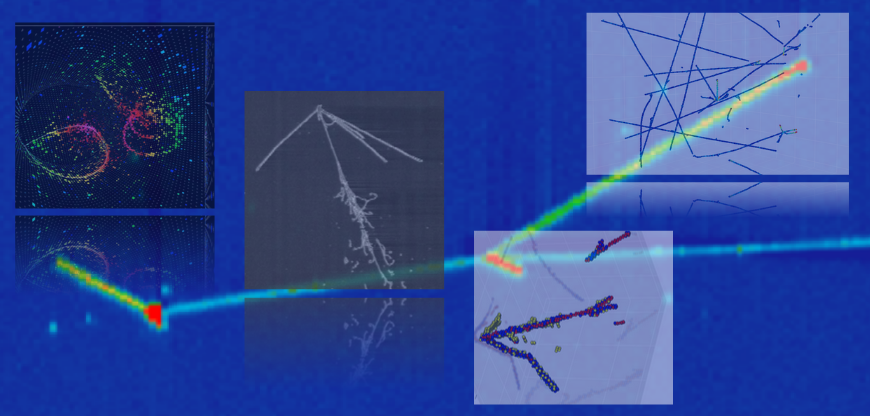
The IceCube Neutrino Observatory is a neutrino detector located at the South Pole consisting of a three-dimensional array of optical sensors embedded deep within the Antarctic ice. It records the Cherenkov radiation produced by charged particles that are generated when neutrinos interact in the ice. The trajectory of the interacting neutrino can be inferred by analyzing the spatio-temporal...
Bridging the gap between data and simulation is one of the most persistent challenges in modern particle physics experiments. Detector calibration aims to shrink this gap by improving the fidelity of detector modeling. Conventional calibration workflows address individual detector effects sequentially. Differentiable simulation offers a compelling alternative: by propagating gradients through...
We present a GPU-native simulation framework for liquid-argon neutrino detectors that enables efficient simulation and signal processing of sparse data in dense GPU-oriented workflows. Traditional dense FFT-based methods in liquid-argon detector simulation are adapted to sparse signals through blockwise processing and analytic tensor operations. We develop an efficient block-sparse binned...
Optical photon tracking in Geant4 is the dominant cost in simulating large neutrino detectors that rely on scintillation or Cherenkov light, and it caps the size of training samples available for ML-based reconstruction. Simphony (old name eic-opticks) is a GPU optical simulation framework built on Opticks (originally developed for JUNO) that runs inside a standard Geant4 job and delivers two...
Liquid argon time projection chambers (LArTPCs) at DUNE and SBN need fast simulation, automated event reconstruction, and precise detector calibration, which are usually handled by separate tools. We built JAXTPC, a single differentiable detector simulator that unifies all of three tasks. Powered by JAX for efficient parallelization, JAXTPC models the full LArTPC response, from charge...
