-
David Caratelli (UC Santa Barbara)18/06/2026, 14:00DatasetsPublic Datasets and Challenges
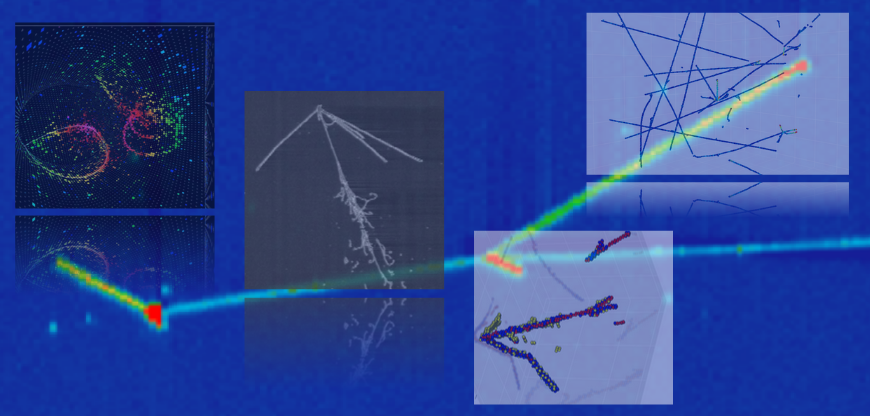
Public datasets from high energy physics experiments can help spur the development of new analysis methods and techniques. This is particularly true in the Liquid Argon Time Projection Chamber (LArTPC) community, where many detectors sharing the same technology have been operating concurrently at Fermilab and CERN, enhancing the benefit of shared, broadly-available datasets for...
Go to contribution page -
Benda Xu (Tsinghua University)18/06/2026, 14:25DatasetsPublic Datasets and Challenges
Next-generation large-scale liquid scintillator detectors (JUNO, KamLAND2 , SNO+ and JNE) rely on tens of thousands of Photomultiplier Tubes (PMTs) to capture single optical photons. Pushing the energy resolution to the physical limit requires extracting sub-nanosecond timing and precise charge from highly piled-up and noisy PMT waveforms. However, the lack of standardized, publicly accessible...
Go to contribution page -
Linyan Wan (Fermilab)18/06/2026, 14:50DatasetsPublic Datasets and Challenges
Neutrino public datasets are increasingly important for advancing neutrino physics by broadening participation, enabling independent cross-checks, and supporting method development beyond large experimental collaborations. However, their scientific utility is limited when users lack access to detector simulation or the detailed detector knowledge needed to interpret reconstructed quantities....
Go to contribution page -
César Jesús Valls (CERN)18/06/2026, 15:30DatasetsPublic Datasets and Challenges
Machine learning is increasingly shaping analysis strategies in high-energy physics, a field characterised by large data volumes and complex detector responses. Progress in this direction depends on accessible, well-documented datasets that enable method development and provide common benchmarks for comparison.
Go to contribution page
We present WAND, a public dataset of simulated events in a water Cherenkov... -
Kazuhiro Terao (SLAC)18/06/2026, 15:55
Choose timezone
Your profile timezone: