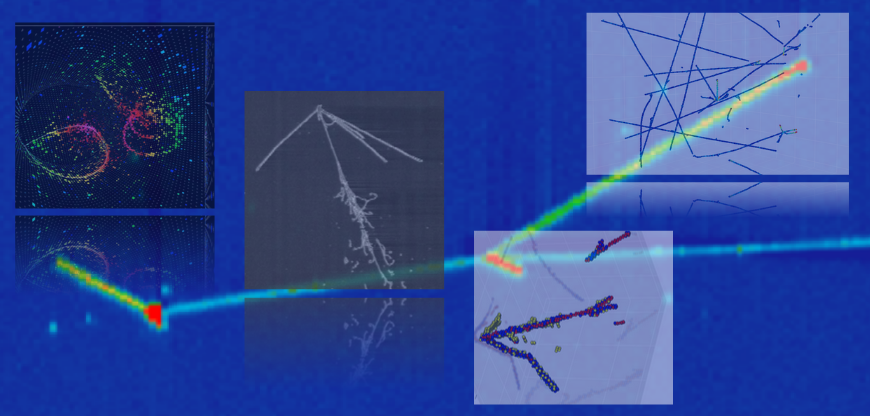
High-resolution neutrino detectors typically rely on fine detector segmentation to obtain detailed spatial information, which introduces substantial complexity, channel count, and cost. In this talk, I will present the deep-learning reconstruction developed for PLATON, a detector concept based on plenoptic imaging of scintillation light in an unsegmented scintillator volume. The central...
NOvA is a long-baseline neutrino experiment studying neutrino oscillations by detecting neutrinos from the NuMI beam at Fermilab. Its physics analysis relies on accurate prong segmentation, which involves matching each hit to its source particle and identifying the particle type. This task has commonly been addressed using a combination of traditional clustering algorithms and convolutional...
Direction reconstruction in liquid scintillator detectors is challenging because the directionality is due to Cherenkov light, which is typically a small fraction of scintillation light especially with high concentrations of the wavelength shifter. We present a deep learning framework tailored to this regime, based on a purpose-built Dual-Temporal Attention architecture that combines...
Accurate photon timing in large liquid-scintillator neutrino detectors requires precise modeling of complex optical processes. These include complex scattering, absorption and re-emission, boundary effects, steel-frame shadowing, and multi-path reverberation. These effects draw a complex picture that is yet intractable for analytic methods and too detector-specific to learn end-to-end. We...
The Jiangmen Underground Neutrino Observatory (JUNO) is the largest liquid scintillator detector in the world, aiming to determine the neutrino mass ordering with an energy resolution of $3\%/\sqrt{E~[\mathrm{MeV}]}$. Accurate analysis of photomultiplier tube (PMT) waveforms is essential for energy resolution. We present a deep learning framework for PMT waveform denoising and reconstruction....
