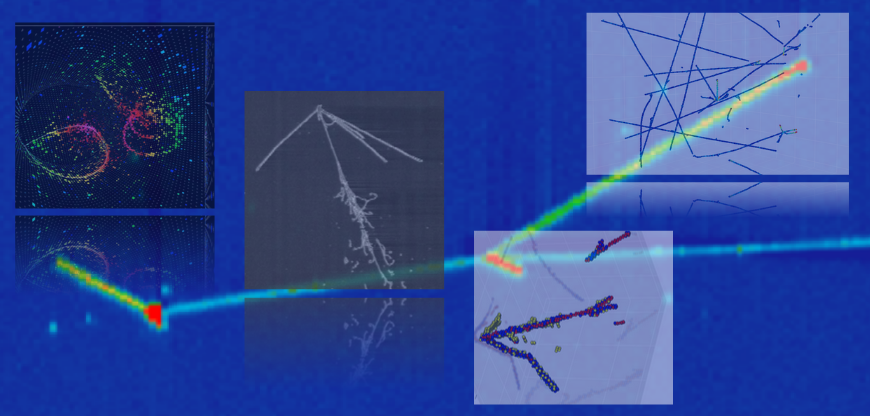
Constraining the ratio of flavors of astrophysical neutrinos at Earth informs neutrino production and oscillation scenarios. The IceCube Neutrino Observatory measures the neutrino flux by recording the Cherenkov light deposited by neutrino secondaries with around five thousand PMTs distributed within a cubic kilometer of ice at the South Pole. Tau neutrinos are difficult to distinguish from...
The Deep Underground Neutrino Experiment (DUNE) is the flagship next-generation neutrino experiment in the United States, designed to decisively measure neutrino CP violation and determine the neutrino mass hierarchy. DUNE employs Liquid Argon Time Projection Chamber (LArTPC) technology, which provides exceptional spatial resolution and enables detailed reconstruction of final-state particles...
Precise reconstruction of high-energy neutrino interactions at the LHC is critical for the physics program of the proposed FASERCal detector, an off-axis neutrino detector for the FASER experiment during LHC Run 4, enabling precision measurements of TeV-scale neutrino interactions in the far-forward region. The detector's highly granular, 3D voxelized geometry produces sparse data that...
The Liquid Argon Time Projection Chamber (LArTPC) technology provides high-resolution spatial and calorimetric information which can lead to great capabilities for particle identification. MicroBooNE was one of the first large LArTPC experiments to operate in a neutrino beam. This talk presents the integration of NuGraph2, a reconstruction tool based on machine learning (ML), into MicroBooNE’s...
Most existing and proposed high energy neutrino experiments have excellent muon charge identification capabilities, enabling the distinction of $\nu_\mu$ and $\overline{\nu}_\mu$ charged current interactions. In contrast, distinguishing $e^\pm$ from $\nu_e$ and $\overline{\nu}_e$ interactions is typically impossible, as they interact quickly within the characteristically dense detector...
I will present a search for a hypothetical heavy neutral gauge boson (Z′) decaying to dilepton pairs using machine-learning classifiers trained exclusively on low-mass kinematic sidebands. A gradient boosted decision tree (BDT) and a multi-layer perceptron deep neural network (DNN) are trained to distinguish Z-peak events from Drell-Yan background events using only 11 raw kinematic features,...
Liquid argon time projection chambers (LArTPCs) provide high-resolution, three-dimensional imaging of neutrino interactions. A persistent challenge in these detectors is neutron reconstruction, as neutrons do not produce direct ionization tracks and are instead inferred through secondary interactions. This leads to incomplete event reconstruction and limits the precision of neutrino energy...
