Speaker
Description
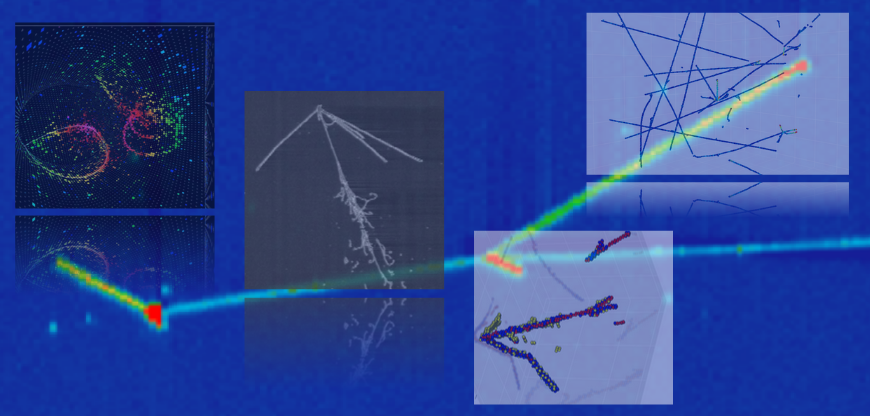
Precise reconstruction of high-energy neutrino interactions at the LHC is critical for the physics program of the proposed FASERCal detector, an off-axis neutrino detector for the FASER experiment during LHC Run 4, enabling precision measurements of TeV-scale neutrino interactions in the far-forward region. The detector's highly granular, 3D voxelized geometry produces sparse data that challenges conventional reconstruction techniques. Our model integrates a Submanifold Sparse Convolutional embedding layer with a hierarchical Transformer encoder, employing attention mechanisms designed to capture features at multiple spatial scales—learning both fine-grained local shower structures and the global event topology. A Perceiver-IO–style bottleneck fuses multi-modal inputs from scintillator voxels, hadronic calorimeters, and muon spectrometers. By leveraging a Masked Autoencoder (MAE) pre-training scheme, the model learns robust representations of particle shower development, overcoming the limitations of standard supervised learning. It is trained via a multi-task objective combining patch energy reconstruction and semantic segmentation, and the resulting encoder is fine-tuned for multi-task classification and kinematic regression with task-specific cross-attention heads. The framework achieves high-purity identification of $\nu_e$ and $\nu_\mu$ charged-current and neutral-current events, and provides first indications of sensitivity to tagging rare $\nu_\tau$ events. We demonstrate that this approach achieves highly accurate reconstruction of particle showers, providing precise estimates of the visible energy $E_\text{vis}$ and missing transverse momentum $p_T^\text{miss}$, as well as reliable reconstruction of lepton and jet momenta for every event, even in complex topologies.
