-
Dowling Wong (Karlsruhe Institute of Technology)16/06/2026, 13:50AI/ML R&DAI/ML R&D
Cryogenic detectors aiming to push detection thresholds to ever lower energies must operate close to the noise limit, where reducing the threshold further risks increasing false triggers. The DELight experiment will use a superfluid helium detector instrumented with large area cryogenic microcalorimeters to probe sub-GeV dark matter via faint quasiparticle and photon signals.
We formulate...
Go to contribution page -
Zeviel Imani (Tufts University)16/06/2026, 14:15Sharable AI ToolsShareable AI Tools
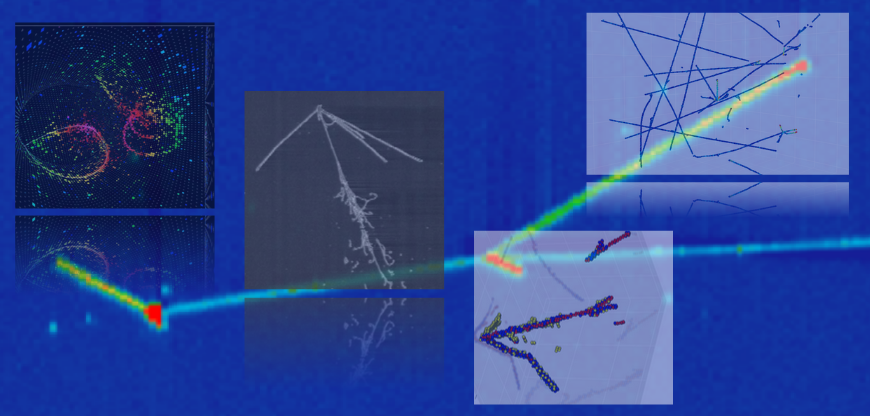
We present a data-driven approach for the generation and inference of 2D LArTPC events. Using a conditional latent diffusion model trained on LArTPC images, we have demonstrated the generation of physically realistic protons. Combining this conditional model with Earth Mover’s Distance (EMD) enables us to perform stochastic gradient descent to efficiently infer the 3D momentum of an input...
Go to contribution page -
Dr V Hewes (University of Cincinnati)16/06/2026, 15:00AI/ML R&DAI/ML R&D
NuGraph3 is a hierarchical Graph Neural Network (GNN) architecture for event reconstruction in neutrino physics experiments, utilized across a range of Liquid Argon Time Projection Chamber (LArTPC) experiments including MicroBooNE, ICARUS, SBND and DUNE. This third-generation architecture leverages a range of different decoders to predict multiple outputs simultaneously on a heterogeneous...
Go to contribution page -
Hilary Utaegbulam (University of Rochester)16/06/2026, 15:25AI/ML R&DAI/ML R&D
The 2x2 Demonstrator is a prototype of ND-LAr, the liquid argon time-projection chamber of the Deep Underground Neutrino Experiment's Near Detector complex. Both the 2x2 Demonstrator and ND-LAr are modular detectors with pixelated charge readouts and inactive regions wherein there is no sensitivity to energy depositions in the liquid argon. These inactive regions are located between the active...
Go to contribution page -
Dr Jose Luis Bonilla Ramirez (University of Wroclaw)16/06/2026, 16:05AI/ML R&DAI/ML R&D
As we enter the era of precision in neutrino physics, it is essential to better understand and limit systematic uncertainties in experimental setups. With the improvement of statistics and measurement quality in detectors, the uncertainties arising from Monte Carlo (MC) generators, used throughout the data analysis process, become more relevant. These uncertainties stem from limitations in the...
Go to contribution page
Choose timezone
Your profile timezone: