Speaker
Description
Previously, we presented Panda (arXiv:2512.01324), a scalable point cloud architecture and training method that learns reusable sensor-level representations directly from raw, unlabeled 3D TPC data. We showed that this method–a UNet-like point cloud encoder coupled with a multi-view self-distillation objective–produces an encoder with foundation-model-like behavior: its self-taught representations reach state-of-the-art semantic segmentation with 1,000x fewer labels, and Panda Detector, a set-prediction head ~5% the size of the encoder, goes from raw inputs to full event reconstruction in a single forward pass with accuracy comparable to current methods, in contrast to modern hierarchical multi-algorithm or -network approaches.
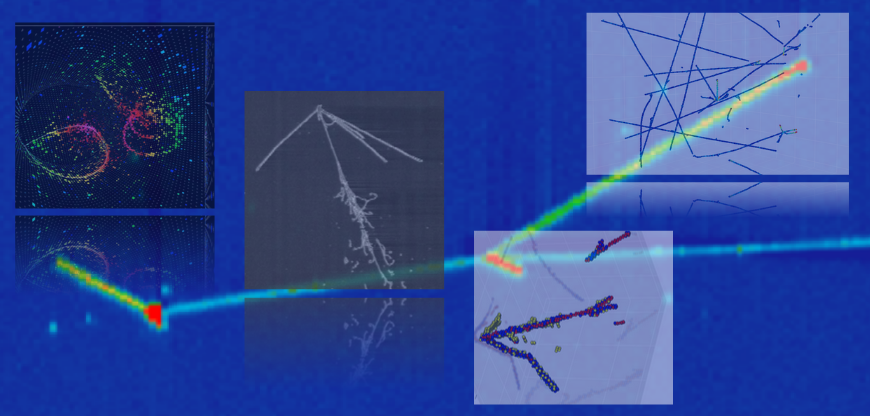
In this talk, we will show that the same methods (Panda and Panda Detector) apply to a fundamentally different data modality. In a LArTPC, the data is a 3D point cloud tracing each particle's path; in a water Cherenkov detector, these paths are never seen. Instead, only the ring of light it casts onto a fixed wall of photomultiplier tubes is recorded. Using the new WAND dataset of simulated Super-Kamiokande-like events, we show that different event types (e/μ, e/π⁰) separate naturally over the course of training. Panda Detector applies neatly to ring counting, PID, and regression of vertex position, direction, and particle energy—again in a single forward pass. We present preliminary results on all of these, including reconstructing invariant mass of neutral pions.
In contrast to detector- (and often analysis-) specific pipelines, this work points towards more general methods that transfer across modalities, perhaps eventually to a single cross-experiment foundation model.
| Contribution types | Standard talk (20min + 5min Q/A) |
|---|