Speaker
Description
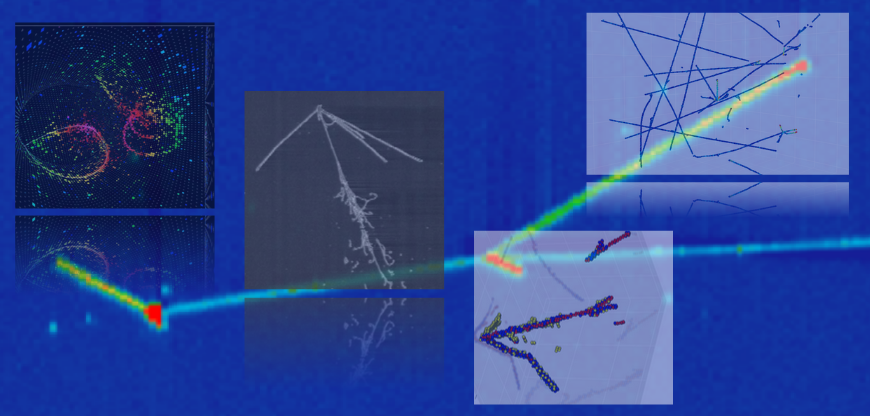
SPINE (Scalable Particle Imaging with Neural Embeddings) is rapidly emerging as the machine learning based reconstruction pipeline of choice across all the LArTPC experiments. Following the remarkable icarus results and successful implementation in SBND and ND-LAR, the next step is it's integration into the DUNE far detectors and 2 of its large scale prototypes at cern. This collaborative work represents the first comprehensive look of SPINE implementation in these detectors.
With the help of sparse CNNs and GNNs,spine spine SPINE performs end to end event reconstruction directly from raw wire data. It chains semantic segmentation, vertexing, particle clustering and kinematic reconstruction within a single coherent framework. We evaluate SPINE's physics performance through calibration level benchmarks such as michel electron tagging, electromagnetic shower energy reconstruction and dE/dx resolution across detector configurations and compare the performance with standard algorithms.
Our results demonstrate competitive performance relative to these traditional algorithms, particularly in complex environments such as overlapping tracks and dense showers. SPINE provides robust results in improved particle identification purity/efficiency and energy linearity. We further investigate the cross detector generalization and domain adaptation, which is particularly critical for scalable deployment in DUNE program.
These results from the spine implementation in protodunes and the far detector establishes a scalable and experiment agnostic framework capable of meeting the precision needed by the next generation neutrino physics. Together these results mark a pivotal step in demonstrating SPINE as one of the leading ML native reconstruction pipeline of DUNE and its prototypes.