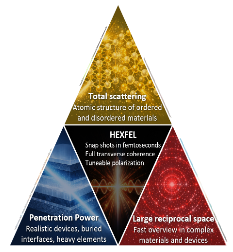
Workshop Goals and Scientific Program Thrusts
The goal of this workshop is to identify and document the key scientific opportunities and technological advancements enabled by a high-energy X-ray Free Electron Laser (HEXFEL) facility. We aim to engage a diverse audience, including materials scientists, chemists, physicists, and engineers, all of whom contribute to the impactful research that can be conducted using high-energy X-ray techniques. The scientific program will focus on three primary areas: Matter in Extremes and Fusion Applications, Materials Science and Engineering, and Chemistry and Chemical Reactions. Each topic will provide ample discussion time to align individual presentations around common challenges, needs, and aspirations for utilizing high-energy X-rays effectively.
By harnessing the unique capabilities of a HEXFEL, we anticipate significant advancements in understanding ultrafast dynamics, structural changes, and reaction mechanisms, ultimately fostering collaborative research efforts across disciplines.
To facilitate meaningful discussions, we will provide example questions related to each topic. While responses to these questions are not mandatory, they are intended to stimulate thought and conversation aimed at maximizing the potential of a high-energy X-ray facility.
-
Topic 1: Matter in Extreme Applications
What are the most significant challenges in studying matter under extreme conditions today, and how can high-energy X-ray techniques provide unique solutions?
Which specific materials or processes would benefit from real-time observation using a high energy X-ray FEL?
What experimental setups are necessary to directly observe phase transitions in materials at extreme pressures and temperatures?
How can high-energy X-rays improve our understanding of defect dynamics in materials used for high energy density applications?
What potential breakthroughs could result from integrating high-energy X-ray capabilities with existing extreme conditions research methodologies?
-
Topic 2: Materials Science and Engineering
What are the key measurement gaps in understanding defect dynamics in advanced materials, and how can high-energy X-ray techniques bridge these gaps?
Which specific materials (e.g., metallic glasses, nanocrystalline materials) present the most promising opportunities for investigation using a high-energy X-ray FEL?
What experimental configurations are needed to conduct time-resolved studies of structural changes in materials during processing or thermal cycling?
How can high-energy X-rays contribute to the elucidation of the relationship between microstructure and macroscopic properties in engineered materials?
What are the potential impacts of integrating high-energy X-ray capabilities into existing materials characterization workflows?
-
Topic 3: Synthesis and Chemical Reactions
What are the primary challenges in observing dynamics during chemical activities and synthesis in real time, and how can high-energy X-ray techniques help overcome these obstacles?
Which specific chemical and catalytic processes would benefit most from time-resolved studies using a high-energy X-ray FEL?
What experimental designs are needed to effectively monitor transient states and intermediates during catalytic reactions or synthesis?
How can high-energy X-rays enhance our understanding of the kinetics and mechanisms of complex chemical transformations?